

A Journey to
Authentic Living
After 55
Part One: The Recalibration
There is a moment — quiet, almost unannounced — when life stops asking you to become
something and begins asking you to reveal who you already are.
For many women, that moment doesn't arrive at 30 or 40. It arrives later, after the expectations have
been met, after the roles have been performed with skill and dedication, after the noise has finally
begun to lose its authority.
After 55, something shifts. Not all at once. Not with fanfare. But unmistakably — and, for those
paying attention, with a clarity that earlier decades rarely offered.
The Life You Built vs. The Life You Want
Most women at this stage have lived several lives already — often simultaneously. You have been
responsible when others weren't. You've been reliable when reliability was taken for granted.
You've been needed in ways that were genuinely fulfilling and in ways that quietly cost you.
Those roles came with structure. And structure, for all its demands, is at least legible. You know
what it wants from you.
What replaces that structure isn't clarity. It's space. And space — especially after decades of filling it
for others — can feel profoundly unfamiliar.
Because for the first time in a long time, the question isn't "What should I do next?" It's the harder,
more honest one: "What do I actually want?"
That question is not small. For many women, it hasn't been asked — or answered — in years. The
work of this stage is learning to sit with it long enough to hear a real answer.
What Reinvention Actually Looks Like
There's a version of reinvention that gets marketed aggressively: new wardrobe, new city, new
business, new relationship. The implication is that transformation is primarily visible — something
you perform for an audience.
But real reinvention after 55 rarely starts with action. It starts with recognition.
Recognizing what you've outgrown. Recognizing what you tolerated out of
obligation. Recognizing that you are no longer willing to perform a version of
yourself that isn't true.
This is not a surface-level upgrade. It's a recalibration — the kind that happens slowly, then all at
once. And it almost always begins before anyone around you notices a thing.
The Permission Phase
Before anything changes externally, something essential has to shift internally: permission.
Permission to change your mind without justifying it. Permission to take up space differently than
you have before. Permission to explore without needing a defined outcome — or an audience who
approves.
This phase doesn't look impressive from the outside. There are no announcements, no visible
milestones. But it may be the most consequential stage of all. Because without it, everything that
follows is simply another performance — just in a different costume.
My own permission phase didn't arrive with a dramatic declaration. It arrived with a decision — one
that came after a long, honest accounting with myself.
I chose to step away from a life that, from the outside, looked very comfortable. A life that, in many
ways, genuinely was comfortable. Which is precisely what made the decision so difficult.
There was no obvious crisis. No single rupture that would have explained it neatly to others. Only a
growing awareness — quiet, persistent — that something essential no longer aligned.
Walking away from something that still holds value, still carries history, still contains a form of
love, requires a particular kind of honesty. Not the kind that explains itself to others. The kind that
refuses to negotiate with what you know, internally, to be true.
There are moments in life when staying begins to require a subtle form of
self-abandonment. And once you see that clearly, it becomes very difficult to
unsee.
Love, at its best, does not ask you to set yourself aside in order to sustain it. When that is what's
required, the relationship is no longer about love — it's about maintenance.
So I chose to create distance. Not as escape, but as a form of clarity.
Relocating gave me something I hadn't experienced in years: uninterrupted space. Space to think
without influence. Space to examine my own patterns without the noise of daily proximity telling
me who I was supposed to be.
It wasn't about starting over. It was about returning to myself.
What This Looks Like for You
Not everyone needs to walk away physically to do this work. That is worth saying plainly.
For some, the shift happens entirely internally — through boundaries that are finally drawn and
held, through honesty that is finally spoken, through the decision to stop participating in what isn't
true. The relocation is inward.
The form is personal. The work is universal.
What matters is that the shift happens. That you stop deferring the question of who you are and what
you actually want — not for some idealized future version of your life, but for the life you are living
right now.
When Creativity Returns
Something predictable happens when you stop performing: creativity returns. Not necessarily as
"art" in the formal sense, but as expression — as a renewed appetite for making, shaping, writing,
designing, exploring.
For many women at this stage, creativity was never lost. It was deferred. Held in suspension while
other demands took priority. Now, with fewer constraints and a deeper, harder-won understanding
of self, it begins to surface again — this time with intention rather than apology.
Pay attention to what you're drawn toward. What you want to make. What feels like yours. Those
impulses are not frivolous. They are directional.
Identity, Rewritten
At this stage, identity becomes less about roles and more about authorship. You are no longer
becoming who you were expected to be. You are deciding — actively, deliberately — who you are
willing to be.
That distinction changes everything. Because it removes the external script. It replaces compliance
with something far more demanding and far more powerful: choice.
And choice, it turns out, is what this whole stage of life has been quietly preparing you for.
This Is Not an Ending
There is a quiet, pervasive misconception that life after 55 is primarily about winding down —
about managing decline, about holding on to what remains. That framing is not just inaccurate. It is
harmful.
For many women, this is the first period in their adult lives when life becomes genuinely,
sustainably internally directed. Less reactive. More intentional. Less about proving something to
someone. More about aligning with what is actually true.
This is not the end of a story. It is the point where the story finally becomes your own.
Where This Journey Can Lead
Some women find their way to creative work they'd postponed for decades. Others launch ventures
that finally reflect their actual values. Some deepen relationships that had gone thin from neglect;
others release ones that had long since served their purpose.
Others experience something quieter but no less significant: the refinement of what already exists.
The removal of what doesn't belong. The choice, made deliberately and repeatedly, of presence over
performance.
There is no single version of what this looks like. That may be the most liberating part of all.
Authentic living after 55 is not about becoming someone new. It is about removing
what isn't you — and allowing what remains to take form without apology, without
urgency, and without waiting for permission from the outside world.
If you find yourself in this space — questioning, redefining, quietly shifting — know this:
You are not behind. You are not lost.
You are arriving. And this is where a different kind of life begins.
— Part One of an ongoing series
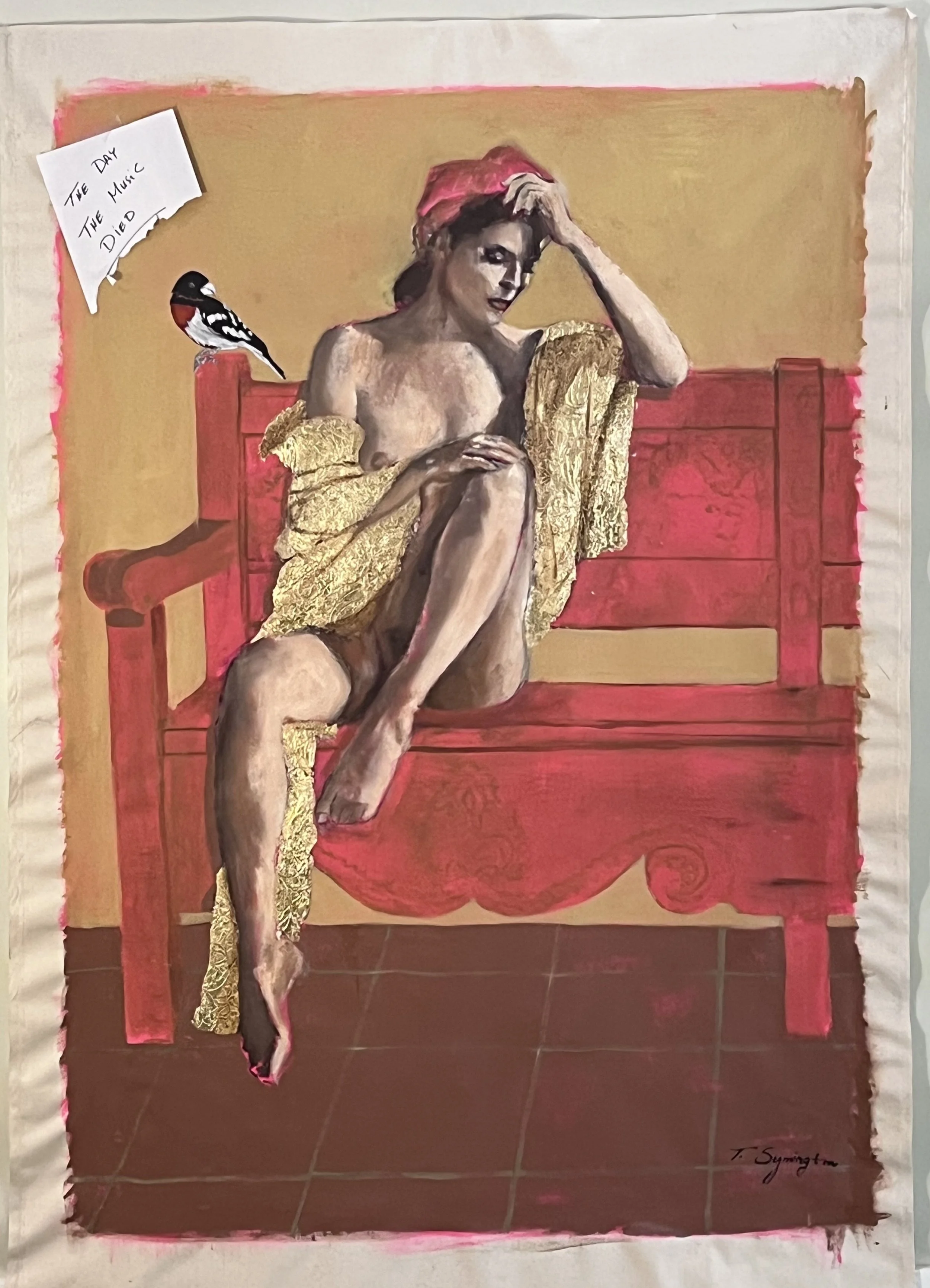
Song Bird - The Day the Music Died
It happens when words are spoken that cannot be unheard … the kind of words that reshape your reality and your belief system. The kind of words that change your life …
A raw canvas, exposed underpainting, construction lines visible … details left out or unrefined … a flat background that only resembles reality, but could very well be a backdrop on a stage … golden threads of those shining moments … all revealing the vulnerable layers of life, … where stepping back to see the bigger picture can help soften the broken edges … while the song bird sits in silence and disappointment …